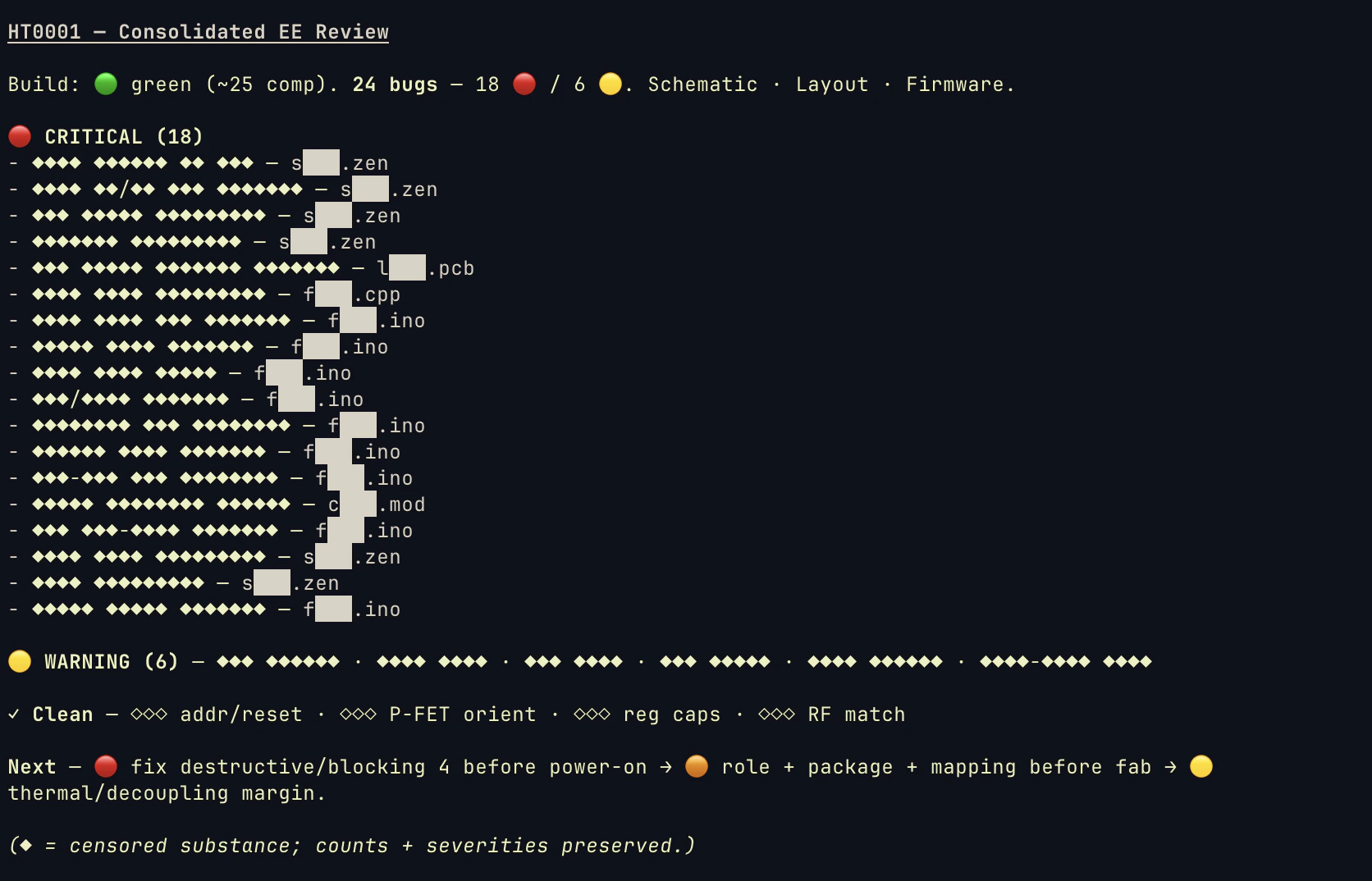
Last week, comma.ai reposted its hardware challenge. It is a good challenge. The premise is simple: they designed a wire harness tester, added bugs to the schematic, layout, and firmware, and asked people to find what was wrong. Our CTO, Lenny Khazan, decided to throw Diode’s internal tooling at it. The challenge ships as a KiCad project, so the first step was importing it into Zener — our open-source language for describing PCBs as code — to give the reviewer the structured representation it needs. With a few prompts, the tool found 22 bugs and won the $1000 prize.
The interesting part is not the prize. The interesting part is what had to exist for that to be possible.
I remember trying the comma challenge when I was in college. It was fun in the way hard things are fun. You start by opening the schematic and thinking you will find a few obvious issues. Then, very quickly, you are deep in the work. You are probing individual nets. You are opening datasheets. You are checking whether a pin is actually the pin you think it is. You are comparing connector mappings, regulator topologies, protection circuits, and interface requirements.
After a few hours, you realize something slightly unsettling: you are not really “checking a board.”
You are reconstructing the intent of the engineer who designed it.
That is what makes PCB review hard.
How a board can fail
A PCB can fail in a few broad ways. The first class is design failure. The schematic is wrong. A pin is floating. A regulator feedback network is incorrect. A reset pin is not pulled to the right state. A part is being used outside its recommended operating conditions. The second class is implementation failure. The schematic may be mostly right, but the layout is wrong. The decoupling capacitor is too far from the pin it is supposed to support. A high-speed signal loses its reference plane. A current path necks down somewhere inconvenient. Differential pairs are routed as if they are decorative. The third class is manufacturing and assembly failure, which is its own universe of problems: wrong parts, wrong packages, bad solder joints, tombstoning, polarity mistakes, and all the ways a thing that was correct in CAD can still become wrong in the real world. Most tools only cover a slice of this. DRC tells you whether your layout violates a set of geometric rules. ERC tells you whether some obvious electrical relationships look suspicious. BOM tools can tell you whether a part exists, maybe whether it is expensive, maybe whether it is out of stock. These are all useful. But none of them really answer the question an experienced EE is asking during a review: “Is this actually going to work?”Intent lives outside the file
That question is hard because the answer depends on intent. A schematic is not just a graph of nets. It is a compressed explanation of what the board is supposed to do. Some of that explanation is explicit: net names, page titles, component choices, annotations. But a lot of it lives outside the file. It lives in the datasheet the engineer read three weeks ago. It lives in the reference design they copied but modified. It lives in the assumption that this enable pin will be driven later, or that this connector pinout matches a cable, or that this ADC input will never exceed a certain voltage. When you review someone else’s board, you have to recover all of that context. This is why the comma challenge is interesting. It is not merely a puzzle. It is a compact version of a real engineering problem: can you inspect a hardware design deeply enough to find the bugs that matter before the board is built?What we are building at Diode